SAMPLE ANSWER
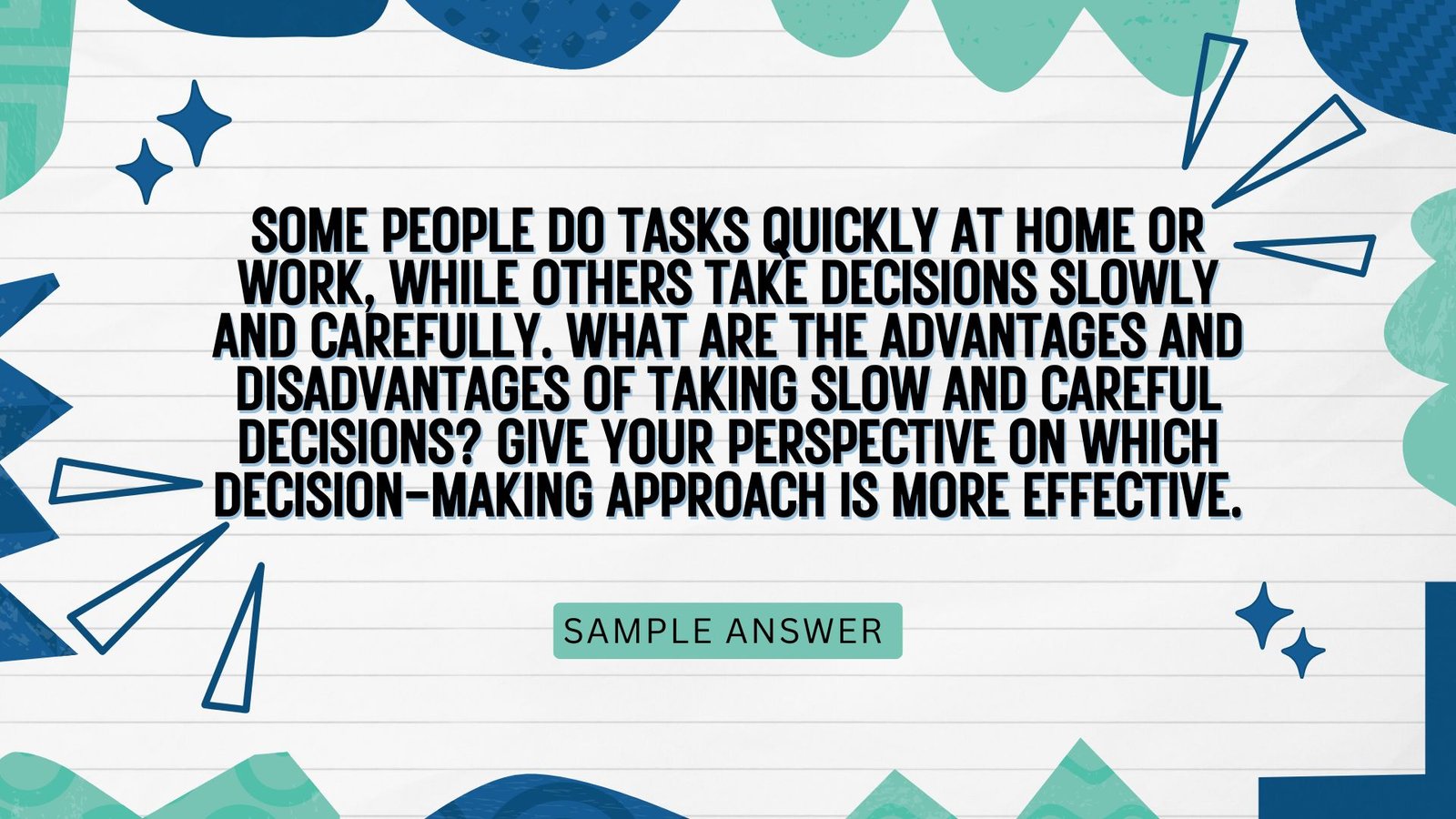
People differ significantly in their approach to completing tasks and making decisions. While some individuals act quickly, others prefer to take decisions slowly and carefully. This essay will discuss the advantages and disadvantages of careful decision-making and present my perspective on which approach is more effective.
Taking decisions slowly offers several clear advantages. Firstly, it allows individuals to analyse situations thoroughly, reducing the likelihood of costly mistakes. Careful decision-makers can evaluate multiple options, identify potential risks, and make choices based on accurate information. This approach is particularly beneficial in areas such as financial planning, healthcare and long-term professional commitments.
However, slow decision-making also has drawbacks. In fast-paced environments, excessive deliberation can delay progress and reduce efficiency. People who spend too much time thinking may experience decision paralysis, causing them to miss opportunities or fall behind deadlines. Additionally, others may perceive them as indecisive, which can negatively affect teamwork and productivity.
In my view, the effectiveness of a decision-making style depends largely on the situation. Slow and careful decisions are more suitable for complex tasks that have long-term consequences, as they minimise errors and promote well-considered outcomes. On the other hand, quick decisions are essential in routine tasks or high-pressure situations where immediate action is required. Therefore, the most effective approach is a balanced and flexible decision-making style, where individuals adjust their speed according to the specific demands of the situation.
To conclude, slow and careful decision-making has both strengths and weaknesses. Although it ensures accuracy and reduces the risk of mistakes, it can be time-consuming and inefficient in fast-moving contexts. A flexible approach that combines careful thinking with timely action is, in my opinion, the most effective.
| Vocabulary Words | Collocations |
|---|---|
| Deliberation | Make informed decisions |
| Judgement | Take a cautious approach |
| Precision | Assess potential outcomes |
| Impulsiveness | Weigh the alternatives carefully |
| Rationality | Reduce the risk of errors |
| Caution | Rely on careful judgement |
| Assessment | Act under time pressure |
| Scrutiny | Avoid rushed conclusions |
| Overanalysis | Engage in thorough analysis |
| Indecisiveness | Miss time-sensitive opportunities |
| Consequences | Adopt a balanced decision-making style |
| Prioritisation | Consider long-term implications |
| Evaluation | Experience decision fatigue |
| Risk-aversion | Evaluate the pros and cons |
| Cognitive flexibility | Adapt decisions to the situation |