SAMPLE ANSWER
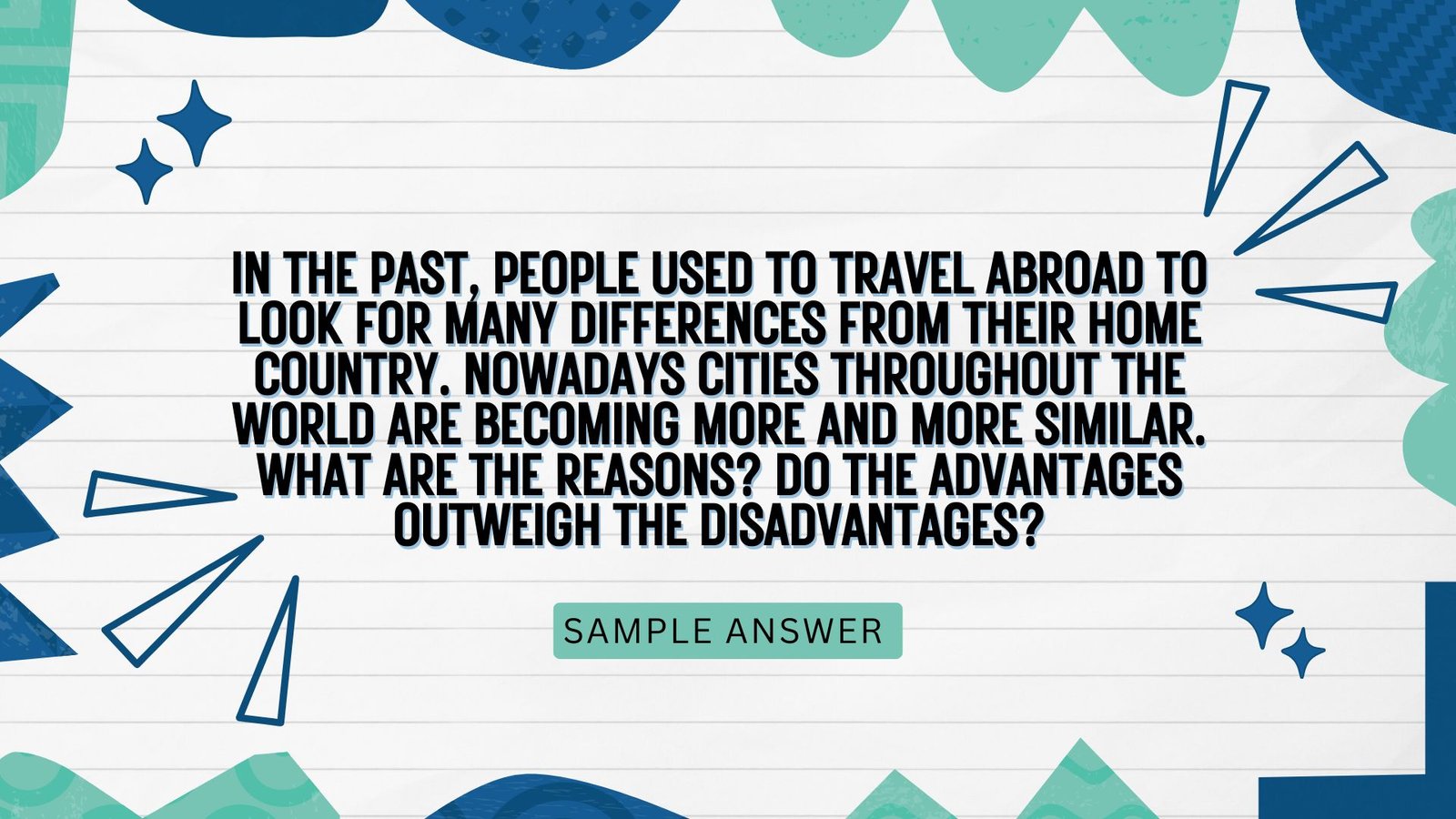
In the past, foreign travel offered people the opportunity to experience cultures and environments vastly different from their own. Today, however, cities around the world appear increasingly similar in terms of architecture, lifestyle and commercial development. This trend is driven by several global factors, and I believe its disadvantages clearly outweigh the benefits.
One major reason for this development is the rapid spread of globalisation. Multinational corporations such as McDonald’s, Starbucks and major clothing brands have established outlets in almost every major city, resulting in a homogenised urban landscape. Furthermore, modern architectural styles—particularly glass skyscrapers, shopping malls and high-rise apartments—are adopted worldwide because they are cost-effective, functional and easy to replicate. Another factor is the influence of digital media and global communication, which spreads the same fashion trends, lifestyle choices and urban planning ideas across countries. As a result, cities begin to mirror one another, losing the distinctiveness they once had.
There are some advantages to this trend. For international travellers, familiar brands, services and infrastructure can make it easier to navigate foreign environments. Businesses also benefit from a standardised market, which allows them to operate smoothly in multiple countries. However, the disadvantages are far greater. When cities become too similar, they experience a loss of cultural identity, making local traditions, architecture and cuisine less visible. This not only affects the uniqueness of each place but also reduces the authentic travel experience that many people seek. Additionally, the dominance of global chains often harms small local businesses, leading to economic imbalance and the decline of traditional craftsmanship.
In conclusion, although the increasing similarity among global cities offers some convenience for travellers and corporations, it ultimately leads to cultural erosion and a less diverse world. Therefore, I believe the disadvantages far outweigh the advantages.
🧠 LEXICAL RESOURCE
High-Level Vocabulary | Useful Collocations |
|---|---|
| homogenised urban landscape | rapid spread of global brands |
| globalisation | mirror one another |
| cultural erosion | loss of cultural identity |
| distinctiveness | decline of local businesses |
| authentic experience | diverse cultural heritage |
| standardised market | global communication networks |
| dominance of global chains | uniform architectural designs |
| replicate architectural styles | international travellers |
| traditional craftsmanship | influence of digital media |